


Understanding motion becomes much easier once you truly understand velocity–time graphs. In this lesson, we look at a velocity–time graph that starts from rest, increases steadily, levels out for a while, accelerates again, and finally slows down. The key question we answer is: 👉 At which part of the graph is the acceleration zero? To understand this, you need to remember one important idea: Acceleration is not about speed, it is about change in velocity. When an object starts from rest and its velocity increases, it is accelerating. When the velocity keeps increasing upward, the acceleration is positive. When the velocity starts reducing, the acceleration becomes negative. But there is one special situation students often miss. 🔹 When velocity remains constant, even if the object is still moving, 🔹 there is no change in velocity, 🔹 and that means the acceleration is zero. On the velocity–time graph, this happens at the flat or horizontal part of the graph. That flat region shows motion at steady speed, and that is why the correct option lies there. This concept appears repeatedly in Physics exams, including GCSE, WAEC, NECO, AP Physics, SAT, and introductory university mechanics. 📌 Watch till the end to fully understand: 👉 How to read velocity–time graphs 👉 How to identify zero acceleration correctly 👉 How to avoid common exam traps If this explanation helped you: ✔ Like the video ✔ Share with a friend preparing for Physics ✔ Drop a comment if you want more graph questions ✔ Subscribe for more clear Physics explanations

In this lesson, I start with a very simple picture. A man applies effort to move a load. The load doesn’t just move by magic. It moves because a force is applied, the load travels a distance, and sometimes that force is not even straight. An angle appears. That angle changes how effective the effort really is. This is where many students get confused in exams, and this is exactly where I slow things down and explain it clearly. From that everyday action of pushing or pulling a load, we move naturally into the idea of energy. I show you how motion itself carries energy, and why anything that is moving has the ability to do something. Then I contrast that with stored energy, the kind an object has simply because it is raised to a certain height. Suddenly, energy stops being abstract and starts to feel real and logical. Finally, we talk about power. Not power as in electricity first, but power as speed. How fast work is being done. Two people can do the same task, move the same load, and still not be equally powerful. One does it faster. That difference matters in physics, and it appears very often in exams. At the end of the lesson, I share a version of power that many students have never seen before. When I mention it, I ask you directly in the video if it looks familiar to you. If you’ve seen it before, drop a comment. If you haven’t, and you want to know where it comes from, tell me and I’ll break it down step by step in another lesson. This video is designed for students preparing for local and international exams, and also for anyone who wants physics to finally make sense instead of feeling like memorization. Watch carefully, save this video, and don’t forget to engage in the comment section. Physics becomes easier when you truly understand the story behind it.

dashboard/ payments/verify/

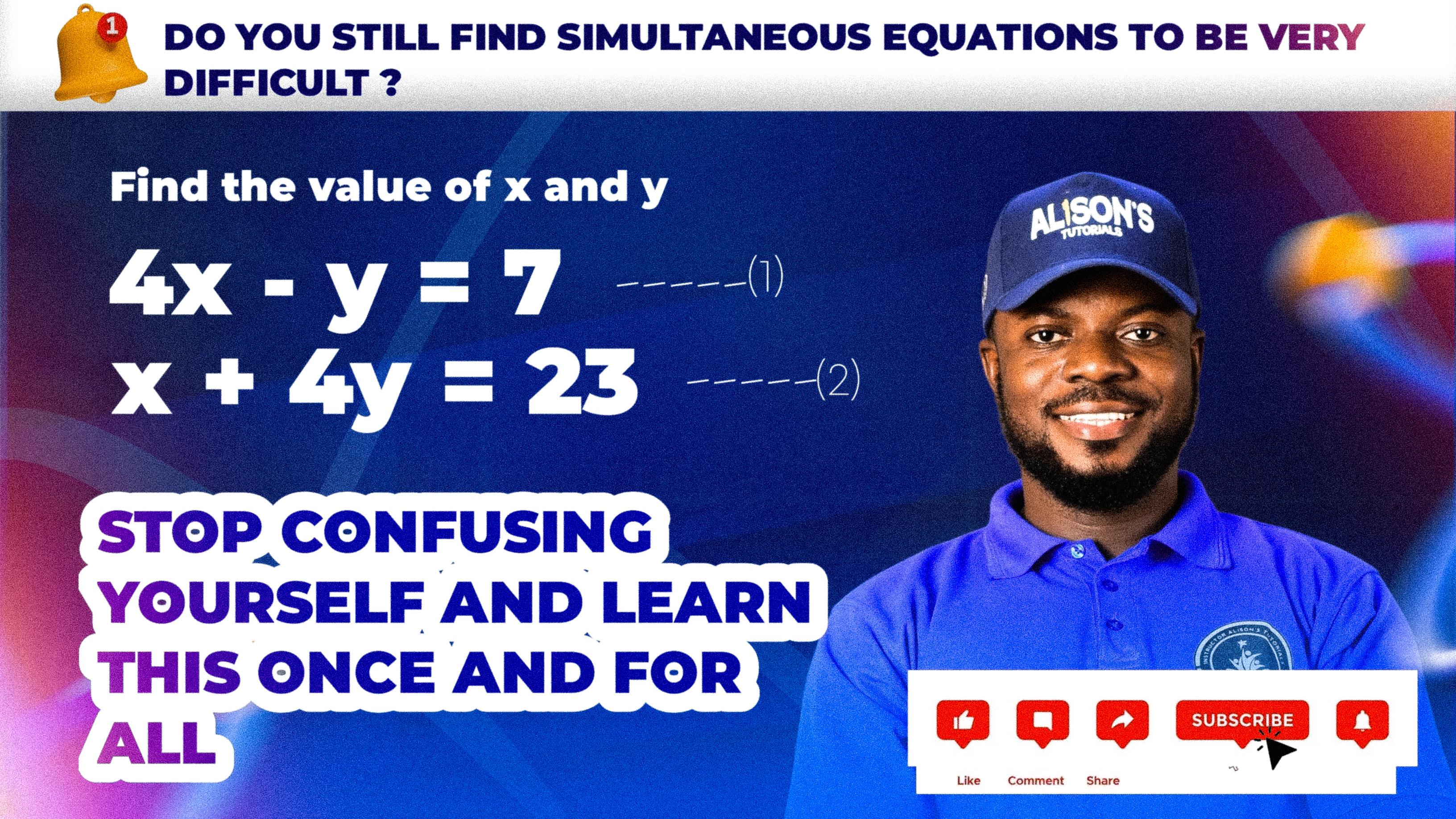
Learn how to solve simultaneous equations step-by-step using elimination, substitution, and graphical methods. Perfect for WAEC, JAMB, GCSE, and IGCSE students who want clear understanding and confidence.

Struggling with logarithms? This course contains 30 carefully solved logarithm questions explained step-by-step for WAEC, GCSE, IGCSE, SAT, and university foundation students. Clear explanations. No confusion. Just results.